Athens
12 Day
CO0004
While traveling through Greece and Turkey, relive the legends of the Templers... Rhodes, Kos, Bodrum.
Day 1: Arrival transfer Athens
Arrival in Athens, transfer to your hotel and free time to recover from travel.
Overnight in Athens.
Day 2: Athens Sightseeing & Acropolis Half Day Morning Tour - Rhodes
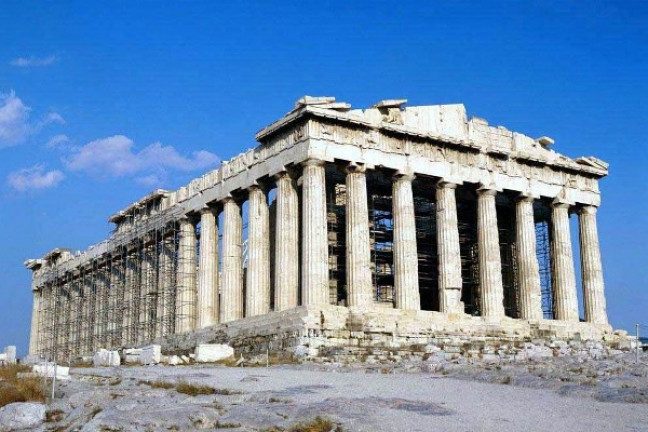
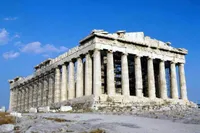
Explore some of Greece’s greatest treasures and the best of modern Athens on this zero-carbon 3.5-hour morning Athens sightseeing tour. With an expert guide, take a coach tour of the major Athens sites, including the Greek Parliament and Panathenaic Stadium. Then, explore the Acropolis on foot to see the majestic Parthenon and other highlights. At the end of the tour some free time and transfer to the port of Piraeus and overnight ferry to Rhodos.
Overnight in ferry (B)
Day 3: Rhodes
Upon arrival check in your hotel. The day at leisure.
Overnight in Rhodes
Day 4: Rhodes
The day at leisure and you can enjoy beautiful beaches in Rhodes or further possible tours on Rhodes : Lindos (with grouprental car), Rhodes Wine Tour (with group only)
Overnight in Rhodes (B)
Day 5: Kos
Depending the proposed ferry connection, we will leave Rhodes and settle in Kos for a few nights. If there will be an evening ferry, you may consider an island tour in Rhodes before going:
Lindos : This picturesque village, ancient in history, located on the south east coast of the island. It is one of the most popular travel locations in Greece and the Mediterranean, because of the relaxed atmosphere, the friendly local inhabitants, and the pristine condition in which you find the town itself, and its well-kept beaches. The old town itself is a maze of picturesque narrow streets with most of the small shops openly displaying wares from unique clothes and jewelry, to pottery, custom made sandals and leather goods, and regional crafts. It’s as shopaholics dream and you can spend hours browsing through the shopstaking a break in the villages many restaurants and ethnic bars.
The Butterflies Valley : In the western side of the island of Rhodes, approximately five kilometers south east of the village of Theologos (or Tholos), lies the Valley of the Butterflies (Petaloudes). This is one of the most attractive destinations on the island. During August, thousands of butterflies of the genus Panaxia (species Quadripunctaria Poda) overwhelm the valley in order to reproduce. During the rainy period, the Butterflies in the caterpillar stage remain in the Mediterranean thicket (arbutus, myrtle and rush) feeding on the foliage. As the end of the wet season approaches, towards the end of May, the final stage is concluded and the butterfly in all her perfection makes her appearance in the form recognizable to us all. They move constantly towards areas of highest humidity is greatest, always following the water ways, as the dry period progresses, they finally arrive at the valley.
Overnight in Kos
Day 6: Kos
The cas-tle of the Knights of the Order of Saint John is situated at the entrance of Kos harbour on what used to be an island in antiquity, communicating with the inland through a bridge that one can still see even today namely the bridge of “Phoinikon (Palm Trees) Avenue.
The cas-tle consists of two defensive precincts. The interior one has four circular towers in the corners; the south-eastern tower forms part of the exterior precinct, which is the larger one of the two, with massive bastions on the four corners, battlements and gun ports. The two precincts are separated by a large moat and communicate with a drawbridge. The cas-tle was built of local stone as well as parts of ancient buildings (columns, architraves, bases etc.) from the ruins of the ancient city. On the upper part of its masonry, one can see many blazons.
Overnight in Kos
Day 7: Bodrum
At leisure, you may take either the morningafternoon ferry to Bodrum whe-re you may want to enjoy the facilities of your hotel.
Bodrum : In the eyes of its lovers, Bodrum, with its low-rise whitewashed houses and subtropical gardens, is the longest-established, most attractive and most versatile Turkish resort. If you want all waterborne distractions laid on by day, and some of the most sophisticated nightlife in Turkey, then Bodrum town and Gumbet in particular will be your dream destination.
Overnight in Bodrum.
Day 8: Bodrum
Bodrum is the modern name of the ancient Halicarnassos. It is on the Western coast of Turkey, on a long peninsula, not far from Rhodes. After the fall of Smyrna (Izmir) to Tamerlane in 1402, the knights of Saint John in Rhodes decided to settle with a stronghold on the Anatolian mainland in Bodrum.
Building began almost immediately under the direction of the German architect Heinrich Schlegelholt. The knights held it until Rhodes itself fell to the forces of Suleyman II the Magnificent in 1522, at which point Bodrum was evacuated. The cas-tle of Bodrum today houses one of the most interesting underwater archaeology exhibition including ship wrecks. Highlights in Bodrum : The Bodrum cas-tle : When the Bodrum cas-tle was designated as a museum it was little more than a romantic ruin attractive only to those interested in traces left by medieval crusading knights on the Anatolian shore. Castle restoration projects and the beautification of grounds were started by the first director, Mr. Haluk Elbe, whose name has been given to the art gallery at the entrance to the museum. But it is the director, Mr. Oguz Alpozen, (retired in july 2005) who deserves credit for implementing the living museum concept which attracts hundreds of thousands visitors and which has earned international renown and recognition in the form of the Museum of the Year Award. In the present time Bodrum Museum of the Underwater Archaeology is directed by Mr.Yaşar Yıldız. The Departments of the Museum are : Carian Princess Hall, Amphora Exhibition, The Dungeon, English Tower, German Tower, Secret Museum, Turkish Bath Exhibition, Glass wreck Hall, Glass Hall, Tektas Shipwreck, Late Roman Shipwreck, Commandant's Tower, Uluburun Shipwrecks, Coins and Jewellery Hall. The
Maussoleum at Halicarnassus :
The city of Halicarnassus, the capital of a small kingdom along the Mediterranean coast of Asia Minor, was ruled by Mausolus, son of Hecatomnus, founder of the kingdom. Mausolus in his time, extended the territory even further so that it finally included most of southwestern Asia Minor. Mausolus, who ruled with his queen Artemisia over Halicarnassus and the surrounding territory for 24 years, spoke Greek and admired the Greek way of life and government. He founded many cities of Greek design along the coast and encouraged Greek democratic traditions. In 353 B.C. Mausolus died, leaving his queen Artemisia, who was also his sister (It was the custom in Caria for rulers to marry their own sisters), broken-hearted. As a tribute to him, she decided to build him the most splendid tomb in the known world. It became a structure so famous that Mausolus's name is now associated with all stately tombs through our modern word mausoleum. The building was also so beautiful and unique it became one of the Seven Wonders of the Ancient World. The Mausoleum overlooked the city of Halicarnassus for many centuries. It was untouched when the city fell to Alexander the Great in 334 B.C. and still undamaged after attacks by pirates in 62 and 58 B.C.. It stood above the city ruins for some 17 centuries. Then a series of earthquakes shattered the columns and sent the stone chariot crashing to the ground. By 1404 A.D. only the very base of the Mausoleum was still recognizable. Crusaders, who had occupied the city from the thirteen century onward, recycled the broken stone into their own buildings. In 1522 rumors of a Turkish invasion caused Crusaders to strengthen the cas-tle at Halicarnassus (which was by then known as Bodrum) and much of the remaining portions of the tomb was broken up and used within the cas-tle walls. Indeed sections of polished marble from the tomb can still be seen there today.
Overnight in Bodrum.
Day 9: Pamukkale
We will take the slow way to Pamukkale. Or, if you prefer, you may want to stay the morning in Bodrum before taking the road.
Pamukkale & Hierapolis :
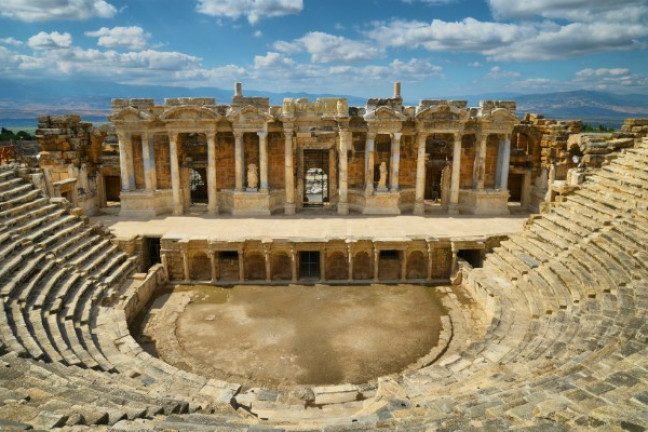
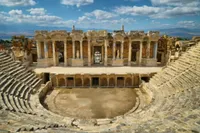
After a trip of about 2,5 hours through the wild landscapes and cotton fields, we will reach Pamukkale, meaning cotton cas-tle in Turkish. This natural site and attraction in south-western Turkey enjoys a temperate climate over the greater part of the year. The ancient city of Hierapolis was built on top of the white cas-tle which is in total about 2700 meters long and 160m high. After a tour on the travertines and a swim in one of the numerous thermal pools, we will continue our tour with the visit of Hierapolis, a UNESCO World Heritage Site. As the hot springs of Pamukkale were used as a spa since the 2nd century B.C. great baths were constructed with huge stone blocks without the use of cement, and consisted of various closedopen sections linked together. There are deep niches in the inner section of the bath, library, gymnasium and other closedopen locations. The complex, constructed in the 2nd century, was visited by people who came to soothe their ailings here. Many of them retired and died here which explains the origin of the large necropolis filled with sarcophagi.
Overnight in Pamukkale.
Day 10: Istanbul
Today, after a morning tour to the archaeological site of Hierapolis and the natural site of Pamukkale, we will relax at the thermal pool of our hotel. An opportunity to be pampered at the spa.
If you prefer, you can take the opportunity to visit any of the sites below :
Aphrodisias :
The ancient city dedicated to Aphrodite, the goddess of Beauty, Love and Fertility. Aphrodisias, a small city in Caria, Asia Minor, was built near a marble quarry which was extensively exploited in the Hellenistic and Roman periods, and sculptors in marble from Aphrodisias became famous in the Roman world. Many examples of statuary have been unearthed in Aphrodisias, and some representations of the Aphrodite of Aphrodisias also survive from other parts of the Roman world, as far afield as Portugal. We will visit the stadium, which is the best preserved in Anatolia, the Temple of Aphrodite, the Tetrapylon, the Theatre and finish our tour with a visit of the museum, an exhibition of the most beautiful artifacts of ancient times.
Or
Laodikea :
One of the seven churches of the Revelation, Laodicea is situated on the long spur of a hill between the narrow valleys of the small rivers Asopus and Caprus, which discharge their waters into the Lycus. It was approximately 10 km south of Hierapolis and, according to Strabo, it was on a major road. The existing remains attest its former greatness. The ruins near Denizli are well preserved and are being substantially renovated (2012). Its many buildings include stadium, baths, temples, gymnasium, theatres, bouleuterion, etc… On the east the line of the ancient wall may be distinctly traced, with the remains of the Ephesus gate; there are streets traversing the town, flanked by colonnades and numerous pedestals. North of the town, towards the Lycus, are many sarcophagi, with their covers lying near them, partly imbedded in the ground, and all having been long since rifled.
In the evening, transfer to the Denizli airport and flight to Istanbul for overnight.
Overnight Istanbul
Day 11: Istanbul
Today we will visit the capital of three empires, the only city spread over two continents, bridge between East and West... a metropolis full of surprizes ! The highlights of this city, the must do’s are the Ayasofya Museum, the Topkapi Palace, the Sultanahmet (Blue) Mosque, the Hippodrome… !
To better feel, live Istanbul, we propose a walking tour (max. 2km – 1,5Mi) : Our visits will start at the Saint Sophia, a basilica built by Constantine the Great in the 4th century and reconstructed by Justinian in the 6th century. Once the symbol of the Ottoman conquest of Istanbul and reconverted to a mosque, the Saint Sophia is today a museum and one of the architectural marvels of all times. Just opposite the Saint Sophia, the Sultanahmet Imperial Mosque : this building of the 16th century is also known as the Blue Mosque because of its magnificent interior decoration of blue Iznik tiles. The Hippodrome was the scene of chariot races in the Byzantine times. The three monuments in the middle, the Obelisk of Theodosius, the bronze Serpentine column and the Column of Constantine, are relics of these glorious times. After lunch, we continue with the visit of the Topkapi Palace, the palace of the Ottoman sultans for about 5 centuries which today houses a marvelous collection of crystal, silver and Chinaware, robes worn by the sultans and their families, the imperial jewels, miniatures. Except from these you will also enjoy wandering in the gardens entering imperial rooms and salons.
The Saint Sophia museum is closed on Mondays, official and religious holidays. This tour does not include the visit of the Harem. The Topkapi Palace is closed on Tuesdays, official and religious holidays.
Overnight in Istanbul.
Day 12: Istanbul
The Bazaars and the Bosphorus : For those who want to enjoy there time in Istanbul other than by visiting, we propose a tour of the famous Istanbul covered and Egyptian bazaars. The Covered bazaar is a labyrinth of streets and passages counting more than 4000 shops whe-re each trade has its own area : goldsmiths, carpet sellers, arts and crafts such as ceramic plates, copperware, brassware, onyx ware and meerschaum pipes. While wandering in this historical shopping mall, enjoy also shopping.
The covered bazaar is closed on Sundays, official and religious holidays.
At the end of the Covered Bazaar, you will enter the Egyptian Bazaar also known as the Spice Bazaar. After lunch, we will head for the Eminönü pier whe-re we will embark a 2 hours cruise on the Bosphorus sailing up along the European shore and back along the Asian shore. The unique view of the Yalis (wooden mansions along the water), the Rumeli Fortress are among the attractions of this cruise.
Overnight in Istanbul.
Day 13: Istanbul
For your last day, we propose at choice : - A boat tour to the Princes' Islands, former land of exile of the Byzantine Princes and today a quiet holidays destination; - An excursion to either Bursa, first Ottoman capital,to Iznik, the first consular city;
- A stroll through the new town “Taksim – Beyoğlu”
- Visit some of the famous museums of Istanbul such as the Museum of Archaeology, the Museum of Ottoman and Islamic Art
- Enjoy a Turkish bath…
Overnight in Istanbul.
The Templers Thank You for the Time You Spent with Them
Time at leisure till transfer to the airport for your home flight.
Notes
1. Depending the seasonalitysome international events (congress, fairs...) prices of the proposed hotels may vary.
2. Due to closure days of some sites and museums, tours may be swapped to ensure the best running of your program. We have endeavored to show these in the program.
Possible program natives :
1. Private excursions at anyall destinations (supplement to be added)
2. Higherlower hotel category (price difference to be reflected)
3. Guide services in other language than English (supplement possible)
4. Possible connection with other tours you have booked with third parties
5. Chauffeur driven rental car (supplement to be added)
6. This is a program proposal. We are open to any additionsreductions you may require. These will be reflected in the new quotation.
Reviews (0)
No Reviews